Book · 2024
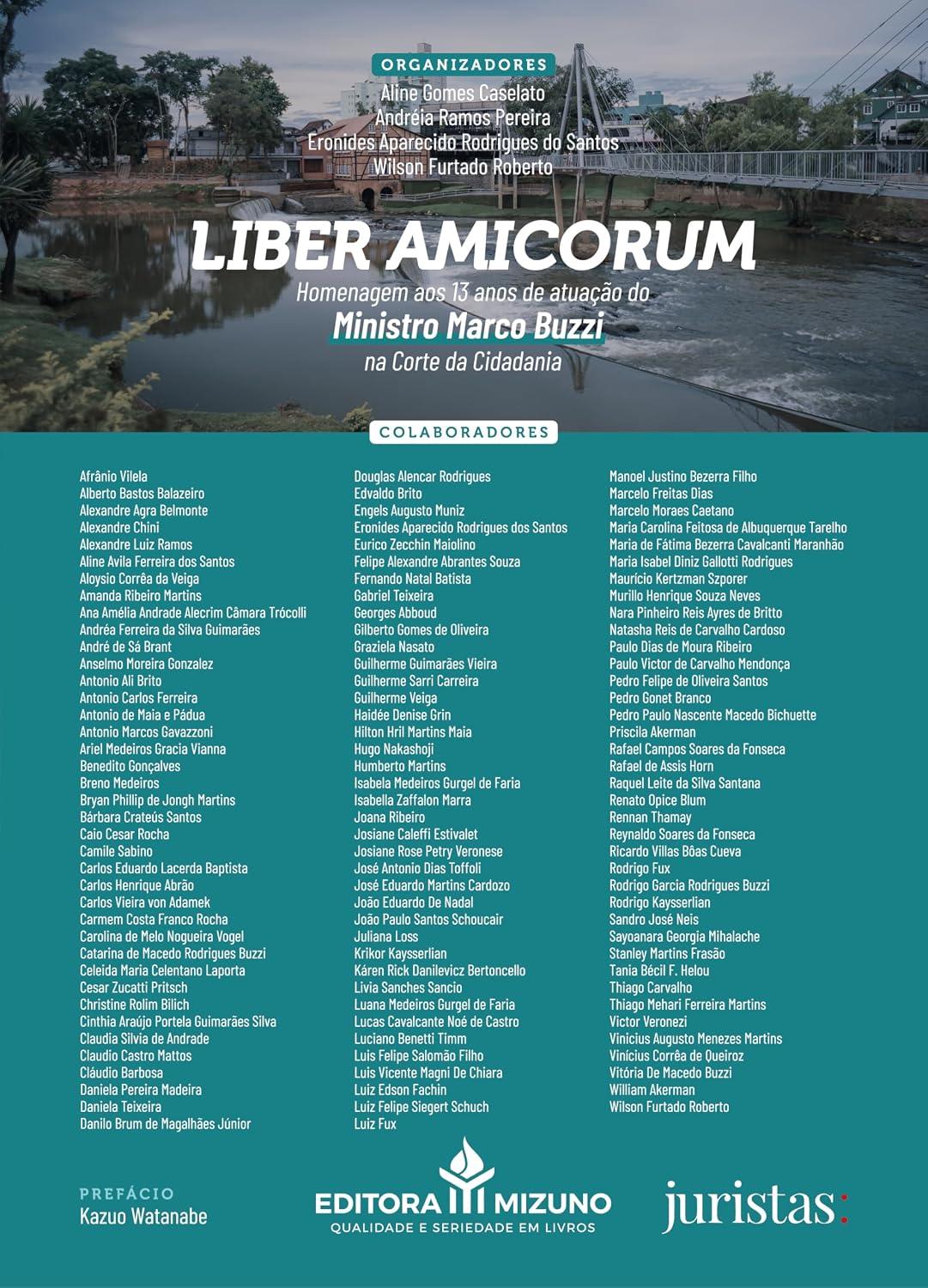
Liber Amicorum: A Tribute to Minister Marco Buzzi’s 13 Years of Service on the Court of Citizenship”
Editora Mizuno


The 15 Years of Justice Raul Araújo Filho at the Superior Court of Justice — 1st edition, 2026
"Jurisprudence and the Development of Brazilian Law: The 15 Years of Justice Raul Araújo Filho at the Superior Court of Justice" is neither a biography nor a memoir. Rather, it brings together legal reflections that examine, from doctrinal, jurisprudential, and pragmatic perspectives, a model of adjudication developed over years of judicial service, with particular emphasis on his tenure at the Superior Court of Justice.
Honoring Justice Raul Araújo means shedding light on what is not always immediately apparent in judicial decisions: the path leading to the decision. This encompasses the manner in which reasons are articulated, the choice of the appropriate word, fidelity to legal principles, and the constant commitment to the integrity of the law. This set of choices has also been shaped by his academic background in both Law and Economics, a combination that has provided him with a broad perspective on legal issues, particularly those involving contracts, economic relations, and Private Law. The result is a legacy recognized for the quality of his decisions, marked by a balance between technical rigor, legal certainty, and the effective protection of fundamental rights. In this context, both the substance of the decision and the form of legal reasoning assume equal importance.
It is impossible to discuss the judge and his judicial work without acknowledging his consistent respect for the adversarial process, the right to a full defense, and collegiality. His opinions reveal not only careful consideration of the parties' arguments, but also genuine engagement with opposing views. The judicial process is conceived as a space for dialogue and as a condition for legitimizing judicial decisions.
Recognized for his rights-protective approach, his rigor in upholding due process of law, and his firm commitment to the protection of fundamental rights, Justice Raul Araújo combines this technical approach with conduct characterized by courtesy and respect in institutional relations, contributing to a more balanced and effective judicial environment.
This conception of the judicial role is captured in his understanding of the judge's fundamental responsibilities: to uphold the Constitution, safeguard democracy, and strengthen institutions. Exercising judicial authority requires this permanent commitment.
The texts gathered in this volume — authored by jurists and scholars of recognized standing within the legal community — engage with this approach to legal reasoning and decision-making. Each article examines aspects of Justice Raul Araújo's legal understanding, his interpretive choices, and the principles that have guided his career as a judge, providing relevant material for academic and institutional reflection.
The essence of this publication lies precisely here: presenting a method of adjudication that endures. After all, not every decision ends with the proceedings — some continue to shape the law, which is constructed every day. It is this model of adjudication that the work offers its readers.
Maria José Fontenelle Barreira Araújo, Aline Gomes Caselato, Cinthia Araújo Portela Guimarães, Cristiane Brito Chaves Frota e José Cândido Lustosa Bittencourt de Albuquerque
Airana Avohay Nascimento de Morais, Alessandra Balestieri, Aline Gomes Caselato, Anderson Luis Motta da Silva Junior, André Fonseca Roller, André R. C. Fontes, Antonio Carlos Ferreira, Benedito Gonçalves, Bernardo Monteiro Ferraz, Bruna Lássio, Caio Cesar Rocha, Cairo Trevia Chagas, Camile Sabino Bezerra Corrêa, Carlos Mohn Roller, Celso Cintra Mori, Cesar Asfor Rocha, Cinthia Araújo Portela Guimarães Silva, Claudio Castro Mattos, Cleíse Martins Costa, Cristiane Brito Chaves Frota, Daniel Carnio Costa, Daniela Teixeira, Danielle Tavares Peçanha, Edilene Lôbo, Edilson Pereira Nobre Júnior, Eduardo Vilar, Élio Wanderley de Siqueira Filho, Elton M C Leme, Estefânia Viveiros, Eurico Zecchin Maiolino, Fernando Braga, Fernando Torreão de Carvalho, Francisco José de Castro Rezek, Francisco Rezek, Francisco Yukio Hayashi, Gabriel de Fassio Paulo, Gil Wender Moreira, Gustavo Favero Vaughn, Gustavo Tepedino, Humberto Martins, Igor Eugênio Torralbo Unello, J. Afrânio Vilela, Joana Carolina Lins Pereira, João Pires de Carvalho Junior, Jorge Mussi, José Cândido Lustosa Bittencourt de Albuquerque, Julia de Baère C. d'Albuquerque, Juliana Menino, Karoline Macedo Geiger de Melo, Krikor Kaysserlian, Livia Sanches Sancio, Lorrane Queiroz, Luciana Lássio, Ludmila Fajardo Fassy, Luis Felipe Salomão Filho, Luiz Fux, Marcelo Nobre, Marco Aurélio Bellizze Oliveira, Marcos Mairton, Maria Augusta Palhares Ribeiro, Maria Isabel Diniz Galotti Rodrigues, Maria José Fontenelle Barreira Araújo, Maria Thereza Rocha de Assis Moura, Massami Uyeda, Mauro Luiz Campbell Marques, Messod Azulay Neto, Nelson Nery Junior, Octaviano Bazilio Duarte Filho, Orlando Magalhães Maia Neto, Paula Greco Bandeira, Paulo Dias de Moura Ribeiro, Paulo Henrique dos Santos Lucon, Paulo Machado Cordeiro, Renata Andréa Joner Parry, Renato José Cury, Reynaldo Soares da Fonseca, Rodrigo Badaró, Rodrigo Kaysserlian, Rommel Barroso da Frota, Rosa Maria de Andrade Nery, Shirlei Castro Menezes Mota, Sidnei Beneti, Teodoro Silva Santos, Thayné J. F. Yaredy, Tiago Asfor Rocha Lima, Valter Pedroso Vitelli e Walter José Faiad de Moura
Editora Mizuno
Editora Dialética